
Why Is My Toilet Running? Common Causes and What Usually Gets Repaired
Learn how flappers, chains, fill valves, water level, and less-common tank problems can cause continuous running or periodic refilling.
By 2ndmynd · · Updated
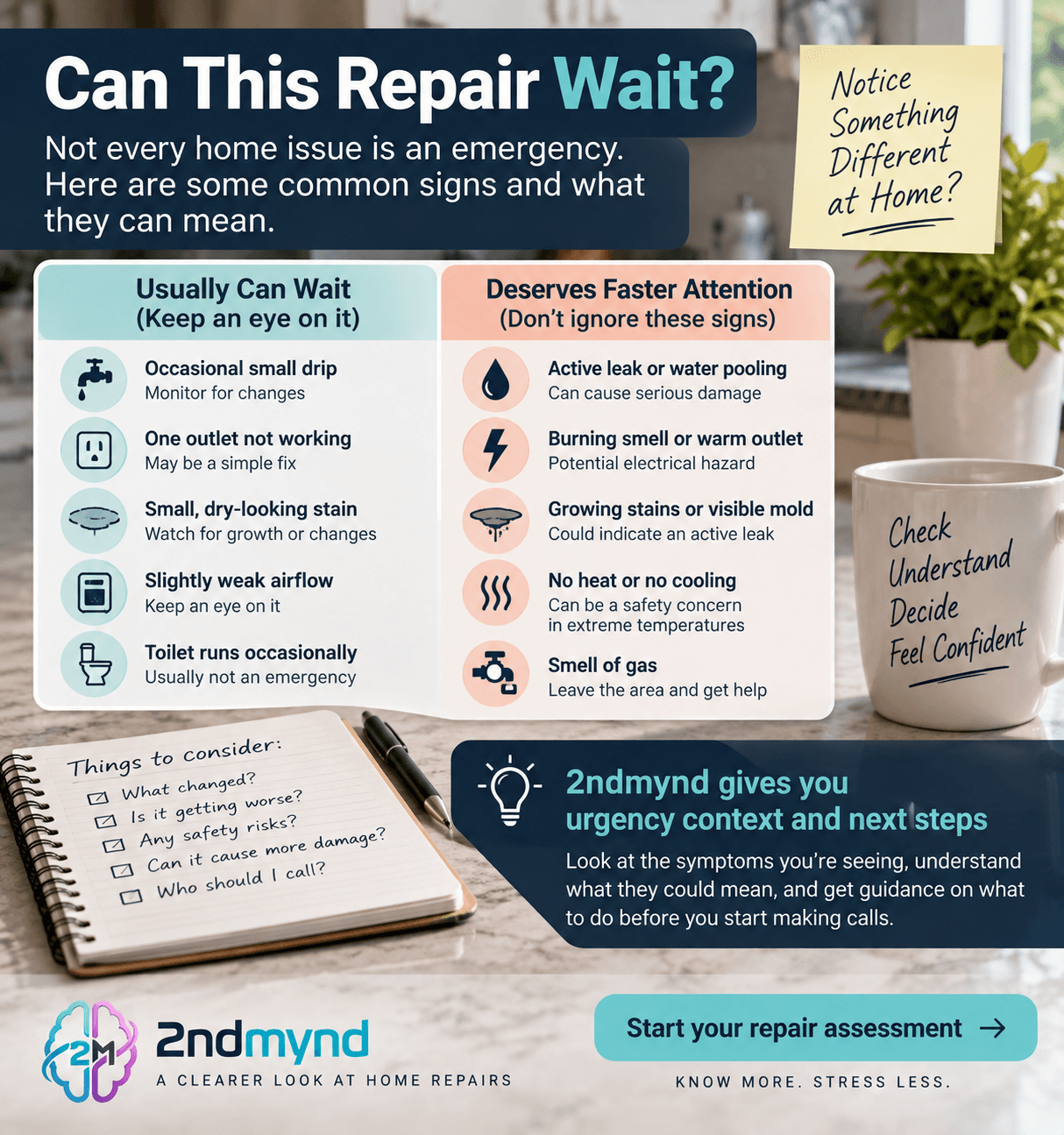
A standard tank-style toilet usually runs because water is escaping from the tank into the bowl or because the tank does not stop filling at the correct level. Common repair paths involve the flapper or seal, chain and handle, fill valve, float or water-level setting, or overflow relationship. The sound alone cannot confirm the failed part, but its timing and a few safe observations can help a professional narrow the repair.
First, identify the pattern
Continuous running means you hear water for long periods after a flush. Periodic refilling means the toilet becomes quiet, then the fill valve turns on again even though no one used it. Those patterns can overlap, but they give useful clues. Continuous flow often keeps attention on fill control or water entering the overflow. Periodic refilling often suggests that tank water is slowly escaping into the bowl.
This guide applies to ordinary residential tank-style toilets. Wall-mounted flushometer valves, pressure-assisted systems, smart toilets, and commercial-style fixtures can have different components and should be described accurately when you call for service.
The flapper or tank-to-bowl seal
The flapper is the flexible part that lifts during a flush and closes over the tank outlet. If it is worn, distorted, misaligned, obstructed, or incompatible with the flush valve, water can seep into the bowl. The tank level drops and the fill valve turns on to replace that water, producing the familiar refill cycle.
A professional may inspect how the flapper seats, whether the sealing surface is damaged, and whether the replacement part matches the toilet. Replacing a flapper is often a contained repair, but a new flapper does not solve every tank leak. If the sealing surface or flush-valve assembly is damaged, the repair scope can be different.
Chain or handle interference
The chain connects the handle mechanism to the flapper. If it is too tight, tangled, caught, or pulled by a sticking handle, the flapper may not close completely. Too much slack can also interfere with consistent operation. A handle that does not return normally is a useful observation to mention.
The usual repair path may be adjustment or replacement of the chain, handle, or related tank hardware. Avoid forcing a stiff component. If the fixture is corroded, unstable, or leaking outside the tank, stop treating it as a simple adjustment and arrange professional evaluation.
Fill valve or float behavior
The fill valve brings water into the tank after a flush and should stop when the target level is reached. A worn, sticking, poorly adjusted, or incompatible valve may continue filling or shut off inconsistently. The float or sensing mechanism tells the valve when the tank is full; its position and movement affect the shutoff point.
A technician may test valve shutoff, check the float or water-level setting, and decide whether adjustment or fill-valve replacement makes sense. A constant hiss near the fill valve and water that continues rising after the tank should be full are useful symptoms, but they do not prove the valve is the only problem.
Water level and the overflow tube
The overflow tube is the open vertical tube in the tank. If the tank water rises high enough to enter it, water can keep flowing into the bowl while the fill valve continues trying to satisfy the tank level. The cause may be a water-level setting, float condition, fill-valve behavior, or component mismatch.
If the toilet is stable, dry, and clearly tank-style, and the tank lid is safe to handle, a visual note or photo of the water level relative to the overflow tube can help. Do not remove an unstable lid, reach into contaminated water, force corroded parts, or create an overflow to test the toilet.
Less-common tank failures
If a correct flapper has already been replaced and the symptom continues, a professional may inspect the flush-valve seat or assembly, gasket, fill tube placement, handle hardware, or visible component damage. Prior repair history matters: tell the provider what was changed, when, and whether the running changed at all.
Cracks, external leaks, severe corrosion, a loose tank, or a toilet that moves at the floor are not simply running-water symptoms. They can change the repair path to tank, fixture, mounting, shutoff, supply, flooring, or leak-source work.
What you can observe safely
Before calling, note:
- Whether the running is continuous or returns in short refill cycles.
- How long after a flush the sound continues.
- Whether the handle sticks or returns normally.
- Whether water enters or approaches the overflow tube, if safely visible.
- Whether the flapper appears to sit flat, without touching it.
- Whether water is on the floor, the fixture moves, or a crack is visible.
- What parts have already been repaired or replaced.
A short video of the sound and a wide photo can be helpful when taken from a safe, dry position. The goal is to document the pattern, not to prove the failed part.
When this is more than routine maintenance
A running toilet without outside leakage is often a routine service issue, but seek prompt professional help when water is leaking onto the floor, the fixture is cracked or unstable, the floor feels soft or damaged, wastewater is present, the shutoff appears damaged, or water is near electrical equipment. Keep clear of wet or unstable flooring. If there is an imminent electrical, flooding, or structural hazard, move to safety and contact the appropriate emergency or utility service.
Do not assume the running sound means all visible water comes from the tank. Water around the base can come from a supply connection, tank connection, condensation, bowl or tank damage, mounting or seal conditions, or another nearby source. An on-site professional should confirm the source.
What usually gets repaired
For an otherwise stable, dry tank-style toilet, common professional outcomes include:
- Flapper or seal replacement.
- Chain or handle adjustment or replacement.
- Fill-valve adjustment or replacement.
- Float or tank water-level correction.
- Flush-valve assembly or sealing-surface repair when simpler parts do not solve it.
- Supply, shutoff, tank hardware, or fixture work when an external leak or damage is found.
Whole-toilet replacement is not the automatic answer to running. It may be recommended when the fixture is cracked, unstable, severely deteriorated, incompatible with available parts, repeatedly repaired, or when the combined work makes replacement more practical. Ask which finding supports repair or replacement.
Handyman or plumber?
An experienced handyman may be a practical option for a clearly identified tank-component repair where local rules allow that work. A plumber is the better choice when the source is uncertain, water is outside the fixture, the shutoff or supply is involved, the toilet is cracked or unstable, the floor may be damaged, prior repairs failed, or piping or permit-related work may be needed.
Licensing rules differ across states and localities. Ask whether the exact proposed task is within the provider's lawful scope and whether they regularly repair that toilet type. For a broader decision, use the plumber-or-handyman guide.
Questions to ask about the estimate
Ask what part was tested, what evidence supports replacing it, whether the quote includes the service call and all tank hardware, and what happens if the first component does not stop the running. If replacement is proposed, ask why a component repair is not recommended and whether fixture removal, disposal, supply connection, mounting, and testing are included.
A low-priced flapper quote and a higher flush-valve or full-fixture quote may not cover the same scope. Compare the diagnosis before comparing totals, then use the plumbing estimate guide to review labor, materials, access, exclusions, and warranty.
What usually changes the price of a running-toilet repair
- Which part failed -- a flapper or chain adjustment is typically a smaller job than a fill valve, and on a two-piece toilet a flush-valve repair usually means removing the tank.
- The shutoff valve -- if the valve behind the toilet is seized or leaks when turned, it may need replacement first.
- Parts matching -- some older, one-piece, or less common toilets use parts that are harder to find.
- The visit itself -- minimum or service-call charges usually apply however quick the fix is.
- Anything outside the tank -- a leak at the base, a loose toilet, or soft flooring turns a tank repair into fixture or floor work.
Labor rates also differ from one market to the next, so no single number fits every home. 2ndmynd serves homeowners across the United States. For hands-on checks and a parts list, use the running-toilet DIY guide. Ask what each quote includes, and read whether a plumber or handyman should handle it if you are deciding who to call.
Before you approve a new toilet
Replacement can make sense for a cracked, unstable, or repeatedly failing fixture. When running water is the only symptom, ask:
- Which part was tested, and what showed it failed?
- Was a flapper, fill-valve, or flush-valve repair considered, and why was it ruled out?
- Does the replacement price include removal, disposal, a new supply connector, the floor seal, and testing?
If the toilet is one of several problems around the house, who to call for a home repair covers the other trades.
Frequently asked questions
Can a handyman fix a running toilet?
A handyman with relevant experience may handle a clearly bounded tank-part repair where local rules allow. Choose a plumber for uncertain causes, external leaks, failed shutoffs, cracks, instability, floor damage, or a repair that did not work.
Does a running toilet need to be replaced?
Usually not automatically. Many running toilets have component-level repair paths. Replacement may make sense for a cracked, unstable, incompatible, badly deteriorated, or repeatedly failing fixture after on-site evaluation.
Why does my toilet run every few minutes?
Periodic refilling often means tank water is slowly escaping into the bowl, commonly around the flapper or seal, but fill-valve, water-level, chain, or flush-valve conditions can also be involved.