
Your AC Is Running but the House Isn't Cooling: What Might Be Happening?
Poor cooling can involve thermostat settings, airflow, filters, coils, the outdoor unit, refrigerant, ducts, controls, equipment, or extreme heat load.
By 2ndmynd ·
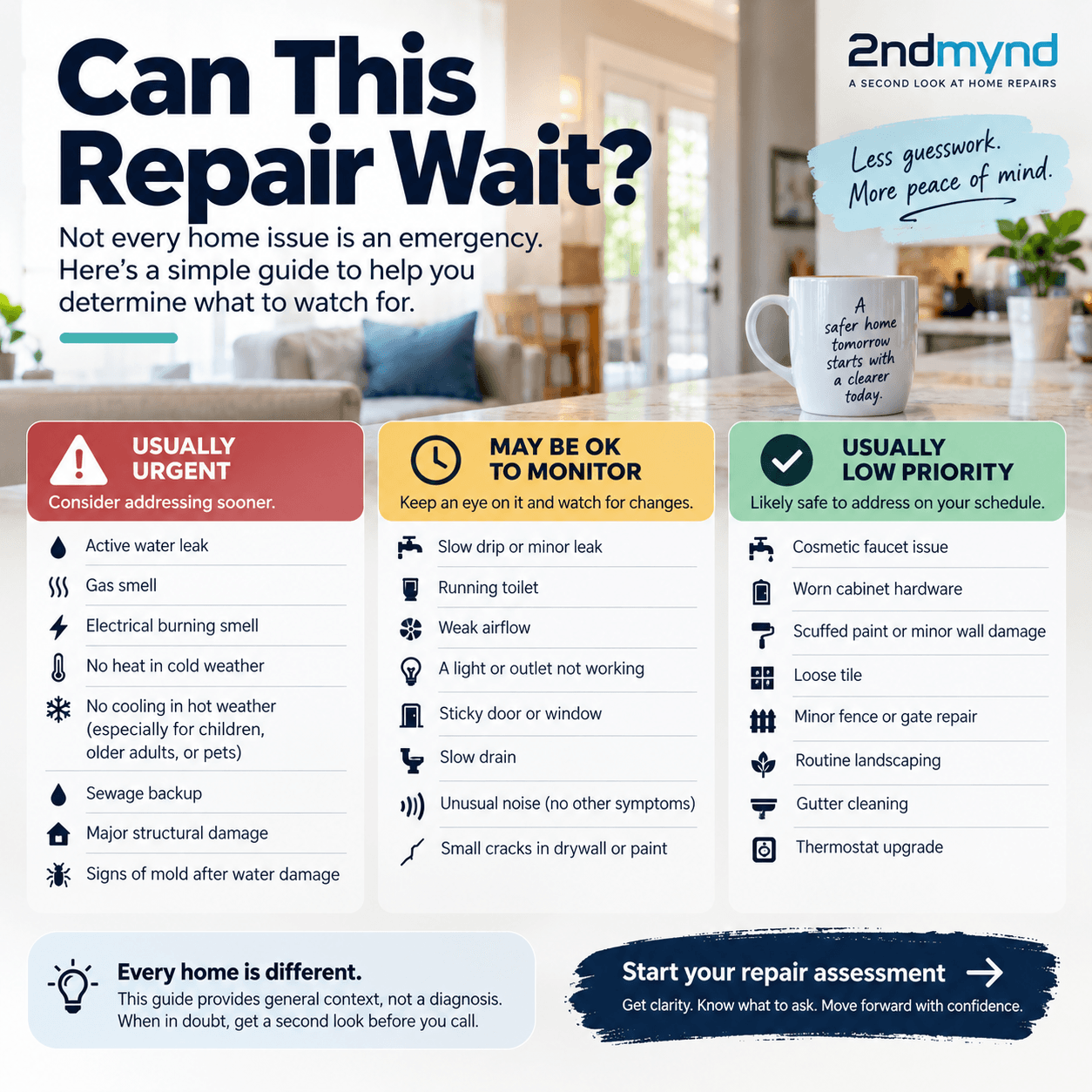
When the AC seems to run but the house is not cooling, first separate a settings or airflow problem from an equipment or heat-transfer problem. A thermostat mode, blocked airflow, dirty or iced equipment, outdoor-unit issue, control or electrical condition, refrigerant-related problem, duct issue, or extreme heat load may be involved. Home observations can narrow the conversation, but a qualified HVAC technician should confirm the cause on site.
Start with heat safety
Cooling loss can become urgent during dangerous heat, especially for children, older adults, people with health vulnerabilities, and pets. If indoor conditions are becoming unsafe, move to a reliably cooled place and use local heat-relief or emergency resources as appropriate. Do not wait for a repair assessment before acting on immediate safety.
Stop using the equipment and move away if there is smoke, sparking, arcing, an electrical burning odor, severe vibration, water contacting electrical components, exposed wiring, gas odor, or a carbon-monoxide alarm. Contact emergency services, the utility, or qualified help as appropriate. Keep equipment covers closed and avoid unsafe roof or attic access.
Confirm what running means
Homeowners may hear the indoor blower, the outdoor unit, or both. Note which appears to be operating from a safe location. Also note whether air comes from the vents, whether it feels cool, room temperature, warm, or variable, and whether the problem affects the whole home or only certain rooms.
This distinction matters. An indoor fan can run even when the outdoor cooling equipment is not operating. Normal-feeling airflow with warm air suggests a different investigation path from very weak airflow. One hot room points more toward a zone or distribution issue than a whole-home complaint. Do not open equipment or reach into a fan to investigate.
Thermostat and control settings
A thermostat in fan-only mode can circulate indoor air without active cooling. An incorrect mode, setpoint, schedule, hold, power issue, error message, sensor location, or control communication problem can also affect cooling. Record the displayed indoor temperature, setpoint, mode, and any visible error code.
Do not bypass a control, jumper wiring, or remove a thermostat or equipment panel. If the display is blank, settings change unexpectedly, or the system does not respond normally, an HVAC technician can evaluate the thermostat, control wiring, equipment controls, and electrical supply. A thermostat symptom does not automatically mean the thermostat itself needs replacement.
Airflow and the filter
A dirty, incorrect, collapsed, or severely restricted filter can reduce airflow. Blocked return grilles, closed or obstructed supply registers, blower problems, coil icing, and duct conditions can produce similar symptoms. Note whether airflow is weak throughout the home or only at certain registers and whether the filter's age and type are known.
If the filter is in a normal, safely accessible homeowner location, follow the equipment manufacturer's routine instructions. Do not open service panels, enter unsafe attics, or operate equipment without required filtration. If airflow is very weak, changing, noisy, or associated with ice or water, arrange professional service rather than assuming a filter is the entire cause.
Dirty or obstructed equipment
Heat must move through the indoor and outdoor coils. Dirt, debris, restricted airflow, damaged fins, blower conditions, or outdoor heat-rejection problems can reduce performance. From a safe ground-level distance, note whether the outdoor unit is surrounded by obvious debris or whether its fan appears to run.
Do not remove guards, reach inside, wash energized equipment, or use tools around the coil or fan. Professional maintenance may include checking filters, blower operation, indoor and outdoor coil condition, controls, drainage, and measured system performance. A gradual loss of cooling can be consistent with maintenance needs, but it does not prove a dirty coil.
Frozen coil symptoms
Visible ice or frost, worsening airflow, water after thawing, or a system that cools briefly and then loses performance may be associated with an iced coil. Restricted airflow, blower conditions, control problems, and refrigerant or heat-transfer issues can all contribute. Ice is a symptom, not a complete diagnosis.
Do not touch or chip ice, open equipment, or keep forcing the system to run when airflow is worsening. Note where ice or water is visible from a safe distance and contact an HVAC technician. Water near electrical components adds an electrical safety concern.
Outdoor-unit or electrical/control problem
If the indoor blower runs but the outdoor unit does not appear to operate, possible investigation areas include controls, electrical supply, a disconnect or breaker condition, a safety device, the outdoor fan, a starting component, or other equipment failure. Home observations cannot identify which component failed.
Do not open the disconnect, equipment panel, or breaker panel; touch capacitors, contactors, wiring, or terminals; or repeatedly reset a breaker. Repeated trips, heat, noise, odor, sparking, or water require prompt professional attention. An electrician may also be needed if the problem is in the building circuit rather than the HVAC equipment.
Refrigerant or heat-transfer problem
Warm air, poor cooling, ice, or long run time can be consistent with a refrigerant or sealed-system concern, but none proves low refrigerant or a leak. Proper evaluation uses professional measurements and must consider airflow and other causes. Simply adding refrigerant does not explain why charge was low or whether another condition exists.
Refrigerant handling is regulated, and work that could release refrigerant belongs to appropriately certified technicians. Do not buy or add refrigerant, open service ports, or attempt a recharge. Ask the contractor what measurements support the diagnosis, whether leak evaluation is included, what repair is proposed, and how refrigerant recovery or charging is handled.
Duct, zone, or distribution issue
If some rooms cool normally and others do not, consider the distribution path rather than assuming the entire system is failing. Closed or obstructed registers, duct leakage or disconnection, damper or zoning problems, insulation, solar exposure, room use, additions, and airflow balance can affect room-to-room comfort.
Tell the technician exactly which areas differ and whether the pattern is new, seasonal, or present since construction or remodeling. Duct inspection may require attic, crawlspace, or concealed access; do not enter an unsafe space. A localized problem can need a different scope from whole-system low cooling.
System capacity and extreme heat
During unusually hot weather, a system may run longer and the indoor temperature may rise more than usual. Building heat gain, insulation, air leakage, windows, shade, occupancy, equipment condition, and system capacity all affect performance. Hot weather alone does not prove that the system is undersized or that replacement is required.
Ask whether the system previously maintained comfort under similar conditions, whether the change was sudden or gradual, and whether recent construction, duct changes, equipment replacement, or thermostat changes came first. Replacement or resizing should be supported by measured performance and appropriate load evaluation, not one hot afternoon alone.
Recent repair or installation
A problem that began after service, installation, an outage, a storm, or remodeling is important context. It does not prove that the prior contractor caused the problem. Share the prior invoice, equipment model information, warranty status, and exact timing with the next technician so they can check relevant configuration, connections, controls, and scope without assuming fault.
Information to give the HVAC technician
Prepare these safe observations:
- Displayed indoor temperature, setpoint, mode, and visible error codes.
- Whether the indoor blower and outdoor unit appear to run.
- Whether vent air feels cool, warm, room temperature, or variable.
- Whether airflow is normal or weak, throughout the home or only in some rooms.
- Any visible ice, water, unusual noise, odor, severe vibration, smoke, or sparking.
- Filter age or recent change, if known without unsafe access.
- Equipment type, model, age, and prior service only when documented or visible safely.
- Recent storms, outages, repairs, remodeling, or a large estimate.
- Whether indoor temperature is continuing to rise and whether occupants or pets need alternate cooling.
These facts help the technician choose the right diagnostic path and reduce the chance that a symptom is treated as proof of one hidden component failure.
What repair paths are common
Depending on measured findings, the visit may lead to settings or control correction, filter or airflow work, blower repair, coil cleaning or repair, condensate-safety work, outdoor-fan or starting-component repair, electrical coordination, refrigerant leak investigation and qualified sealed-system work, duct or damper repair, or a discussion of major equipment condition.
Whole-system replacement is one possible downstream decision, not the default explanation for weak cooling. Ask what was measured, which component or condition was confirmed, whether repair is available, what remains uncertain, and how age, warranty, parts availability, efficiency, and expected reliability affect the recommendation.
Compare HVAC estimates by diagnosis
A maintenance quote, refrigerant diagnostic, component repair, duct project, and system replacement are not comparable totals. Separate service call, testing, labor, parts, refrigerant handling, permit or electrical work, access, commissioning, warranty, and exclusions. If two contractors propose different solutions, ask each to address the other's diagnostic assumption.
Use the guide on why repair estimates vary to understand legitimate differences, and the side-by-side checklist before approving a major repair or replacement.
Frequently asked questions
Why does my AC run without cooling the house?
Possible investigation areas include thermostat settings, restricted airflow, a dirty or iced coil, blower or outdoor-unit conditions, controls or electrical supply, refrigerant or heat-transfer concerns, ducts, and extreme heat load. On-site measurements are needed to confirm the cause.
Does warm air mean my AC is low on refrigerant?
No. Warm air can have several causes, and symptoms alone do not prove low refrigerant or a leak. A qualified technician should check airflow, controls, equipment operation, and the refrigerant circuit with appropriate measurements.
Should I replace an AC that is not cooling?
Not based on the symptom alone. Ask what condition was confirmed, whether repair is available, and how equipment age, warranty, parts availability, efficiency, and measured performance support repair or replacement.